

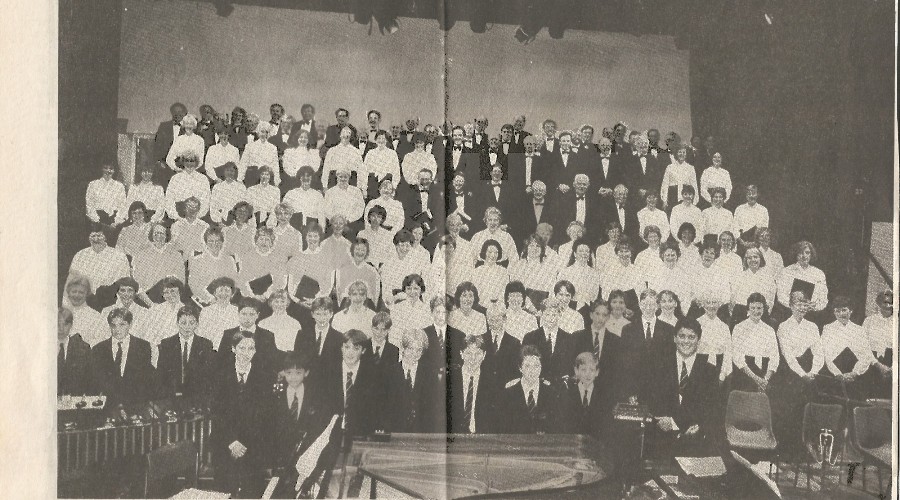
Carmina Burana
Soprano: Diana Vivian
Counter-Tenor: Angus Davidson
Baritone: Geoffrey Davidson
Piano: Lesley-Anne Brown
Piano: Roderick Elms
Lord Wandsworth College Junior Choir, Director Jacqueline Protheroe
Waverley Percussion Ensemble
Piano Duets:
Rossini: La Danza (Tarantella Napolitana)
Bizet: Nocturne and Galop (from Jeux d'Enfants suite)
Arthur Benjamin: Jamaican Rumba (encore)
Vocal Solos:
Frank Bridge: Go Not, Happy Day; Love Went A-Riding (Baritone solo)
Finzi: Fear No More the Heat o' the Sun; It was a Lover and His Lass (from song cycle Let Us Garlands Bring) (transposed for Counter-Tenor)
Brahms: Neue Liebeslieder Waltzes (Choir, Soprano Solo, Baritone solo, and two pianos)
Thomas Gauger: Gainsborough (Percussion ensemble)
Interval
Carl Orff: Carmina Burana
Farnham Maltings Silver Jubilee Celebration
Reviews
"Glorious Musical Salute to 25 years of The Maltings"
The following review of the concert was contributed to, and published in, The Herald newspaper.
Saturday evening was the occasion for one of the most prestigious musical events celebrating the Silver Jubilee of the Farnham Maltings. Patrons for the evening included Kar Ling Kwong, Godwin's Limited, Hamptons, and Strand Insurance. The bright newly decorated forum was a welcome sight, as was the packed Grand Hall.
Seven rows of stalls, which no doubt would have been filled as well, had to be removed to accommodate the large forces involved: the Waverley Singers, who celebrate their 40th anniversary next year (120 strong), three soloists, two pianos, six percussion players and lastly, but by no means least, the Junior Choir of Lord Wandsworth College (Director Jacqueline Protheroe); all under the assured control of Malcolm Hicks who has directed The Waverleys since 1981.
The attractive program was light-hearted, in line with the happy atmosphere prevailing. Lesley-Ann Brown, the Waverleys’ official accompanist, and Roderick Elms offered a rousing start with piano duets. “La Danza” (Tarantella Napolitana) by Rossini was followed by two pieces, Nocturne, and Galop from Bizet’s “Jeux d’enfants” suite and the warm applause produced an encore, Arthur Benjamin's “Jamaican Rumba”. All pieces delightfully performed.
Then followed songs by two of the soloists. Geoffrey Davidson gave us “Go not, happy day" and "Love went a-riding" by Frank Bridge and Angus Davidson sang "Fear no more the heat of the sun" and "It was a lover and his last" from Gerald Finzi’s cycle "Let us garlands bring" of 1940. It was interesting to hear these songs transposed for the counter-tenor. All were beautifully sung with excellent diction and sensitively accompanied by Roderick Elms and Lesley-Ann Brown respectively. These songs are first class examples of English songwriting.
Brahms "Neue Liebeslieder Walze", Op. 65, was the Waverley Singers’ first offering with Diana Vivian and Geoffrey Davidson. This group of 15 part-songs were written in 1874 following the great success of the "Liebeslieder Walzer”, Op. 52 of 1868-9. Not so well known as the first set, perhaps because they are not so immediately attractive, they are nevertheless excellent examples of Brahms’ vocal writing. Generally performed by a quartet or small group, I do not know if they are often sung by such a large choir. Four songs were soprano solos, and one was for baritone. The performance reflected great credit on the discipline of the choir and the expert control by Malcolm Hicks. The soloists’ contributions were admirable.
The first half was concluded by the six percussionists: Graham Cole, Grahame King, Alex Neal, Julian Poole, Roy Sinclair and Julian Walton, showing us what they can do. The original choice for the programme was dropped in favour of Thomas Gauger’s suite "Gainsborough". Gauger is an American composer, but at this stage I cannot find out anything else about him. However, this is an engaging work with a delightfully gentle middle movement. The sound of xylophone, marimba, celeste and bells in addition to the usual timpani, side drum, bass drum and cymbals was tremendously exciting, and it was a terrific performance by these six young players.
The major work of the evening after the interval was "Carmina Burana". The Waverley Singers sang this, the best-known work by Carl Orff, 24 years ago at a fundraising concert for The Maltings and it was very fitting that it should be repeated on this special occasion. 12 members of the choir at the earlier performance are still there!
What can one say about "Carmina Burana"? First performed in 1936, it was an immediate success, and Orff withdrew virtually all his previous output. His later works, including two more cantatas "Catulli Carmina" and “Trionfo di Afrodite" to complete the trilogy, concentrated on primitive simplicity to support his work as an educationist.
The idiom is of deliberate naivety. There is hardly any counterpoint and the harmony is most fundamental. There is much use of short and repeated phrases and rhythmical formulae, but at the same time there are some delightfully gentle movements and some great tunes. Praised and scorned by critics and musicologists, the work is, in short, great fun and rewarding to both performers and listeners.
The language of the poems, although possibly puzzling, consists of medieval Latin, old German and macaronics and it is conjected that some of the erotic poems maybe the works of Peter Abelard!
I consider the performance in toto to be a great success. The work was written for a large orchestra, two pianos, and a great deal of percussion. The absence of the orchestra did not seem to adversely alter the effect of the work; in fact the volume of sound produced by the present forces amply filled the hall.
There appeared to be a slight reticence in the tenors and basses, but I attribute this to the masking of sound by the Proscenium curtaining, as the men were positioned quite high up at the back of the stage. The ladies, however, came through with some beautiful tone.
The soloist acquitted themselves admirably: Geoffrey Davidson had the lion's share and I particularly enjoyed “Omnia Sol temporat”, (No.4). Angus Davidson had to wait until Part 2, "In Taberna" before getting his chance in one movement only, "Olim lacus colueram", (No. 12), in which a swan gives a sad commentary as he is roasted and served up on a salver. In spite of the grizzly subject, this is one of the most affecting movements and the counter-tenor certainly made the most of it; a most heart-rending performance.
Diana Vivian also had to wait until Part 3, “Cour d’ Amour”, but it was well worth waiting for. The soprano solos, four of them, are very rewarding and the last and shortest, "Dulcissime”, is frighteningly cruel with a climactic top D, as the young girl finally surrenders. We need not have worried; Diana, in magnificent voice, sailed through her part with ease. I am told there are some sopranos who will not include "Carmina” in their CV because of that top note! Diana is becoming a favourite with the Waverleys as she has sung with them on at least three occasions, her last being a memorable performance of Vaughan Williams "Sea Symphony".
The Lord Wandsworth College Junior Choir made a noteworthy contribution to the performance; singing with great assurance, good tone and diction and with obvious enjoyment. The whole work was of course held together by the choir who responded to Malcolm Hicks’ precise direction with fervour.
The men's most important chorus on their own is “In taberna quando sumus", something they can really get their teeth into, and this they did in fine fashion with good enunciation. The ladies were excellent in several important solo efforts. The percussion acquitted themselves in first class fashion, as did the two pianists, who were playing non-stop from start to finish, and in substitution for a full orchestra had a pretty formidable task.
The finale, culminating in everything going full blast, notably the tam-tam, was a fitting climax to a memorable and highly successful concert.
After the concert, a reception was held attended by the contributors to the evening, including the twelve members of the choir mentioned above. The Mayor of Waverley, Councillor John Wootton, and Councillors from Farnham and Waverley were also present and the Mayor thanked and congratulated all those who had made the evening so successful.
Gallery
Youtube