

Brahms Requiem
Soprano: Maria Bovino
Bass: Mark Wildman
Organ: Murray Stewart
Tilford Bach Orchestra
Leader: John Ludlow
Brahms:
- Schicksalslied,
- Warum ist das Licht,
- O Heiland Reiss, Ach Arme Welt
---Interval----
Brahms: Requiem
Reviews
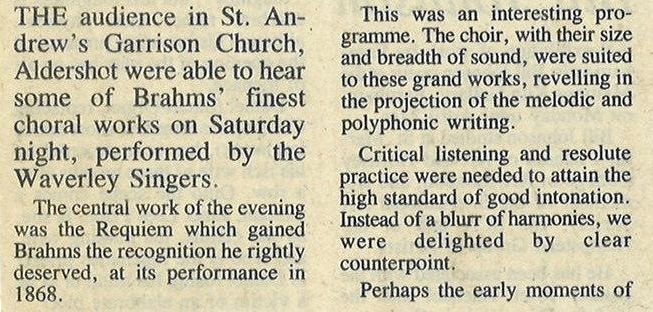
Taxing programme produces some fine choral singing
The following review by Jacqueline Berry appeared in the Aldershot Herald on 6 April 1990.
The audience in St Andrew's Garrison Church, Aldershot, were able to hear some of Brahms' finest choral works on Saturday night, performed by the Waverley Singers. The central work of the evening was the Requiem, which gained Brahms the recognition he rightly deserved at its performance in 1868.
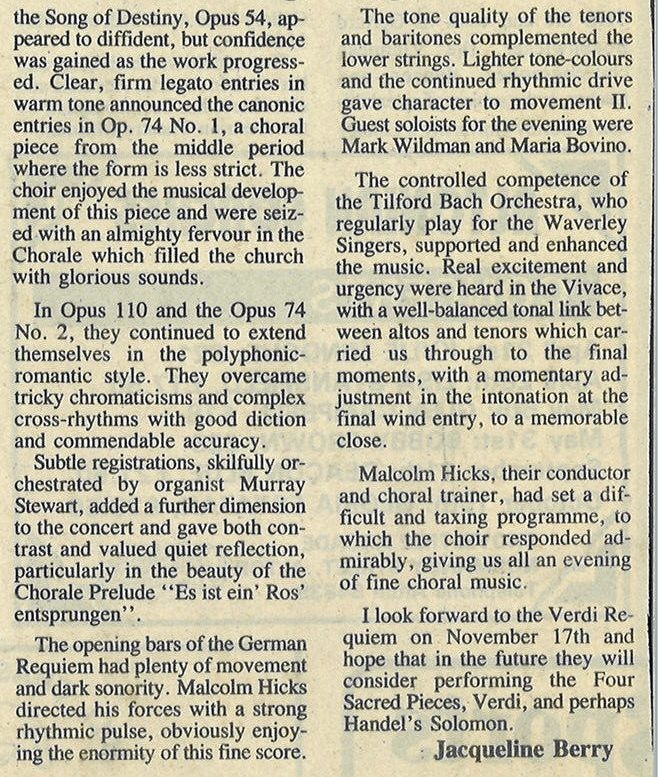
This was an interesting programme. The choir, with their size and breadth of sound, was suited to these grand works, revelling in the projection of the melodic and polyphonic writing. Critical listening and resolute practice were needed to attain the high standard of good intonation. Instead of a blur of harmony, we were delighted by clear counterpoint. Perhaps the early moments of the Song of Destiny, appeared to be diffident, but confidence was gained as the work progressed. Clear, firm legato entries in warm tone announced the canonical entries in Opus 74, No. 1, a choral piece from the middle period where the form is less strict. The choir enjoyed the musical development of this piece and were seized with an almighty fervour in the chorale, which filled the church with glorious sounds.
In Opus 110 and the Opus 74, No. 2, they continued to extend themselves in the polyphonic romantic style. They overcame tricky chromaticisms and complex cross rhythms with good diction and commendable accuracy. Subtle registrations, skilfully orchestrated by organist Murray Stewart, added a further dimension to the concert and gave both contrast and valued quiet reflexion, particularly in the beauty of the choral prelude "Es ist ein’ Ros entsprungen".
The opening bars of the German Requiem had plenty of movement and dark sonority. Malcolm Hicks directed his forces with a strong rhythmic pulse, obviously enjoying the enormity of this fine score. The tone quality of the tenors and baritones complemented the lower strings. Lighter tone colour and the continued rhythmic drive gave character to movement II. Guest soloists for the evening were Mark Wildman and Maria Bovino.
The controlled competence of the Tilford Bach Orchestra, who regularly play for the Waverley Singers, supported and enhanced the music. Real excitement and urgency were heard in the Vivace, with a well-balanced tonal link between altos and tenors which carried us through to the final movements, with a momentary adjustment in the intonation at the final wind entry, to a memorable close.
Malcolm Hicks, their conductor and choral trainer, had set a difficult and taxing programme to which the choir responded admirably, giving us all an evening of fine choral music. I look forward to the Verdi Requiem on November 17th and hope that in the future they will consider performing the Four Sacred Pieces, Verdi, and perhaps Handel's Solomon.
Gallery

Youtube