


Beethoven Missa Solemnis
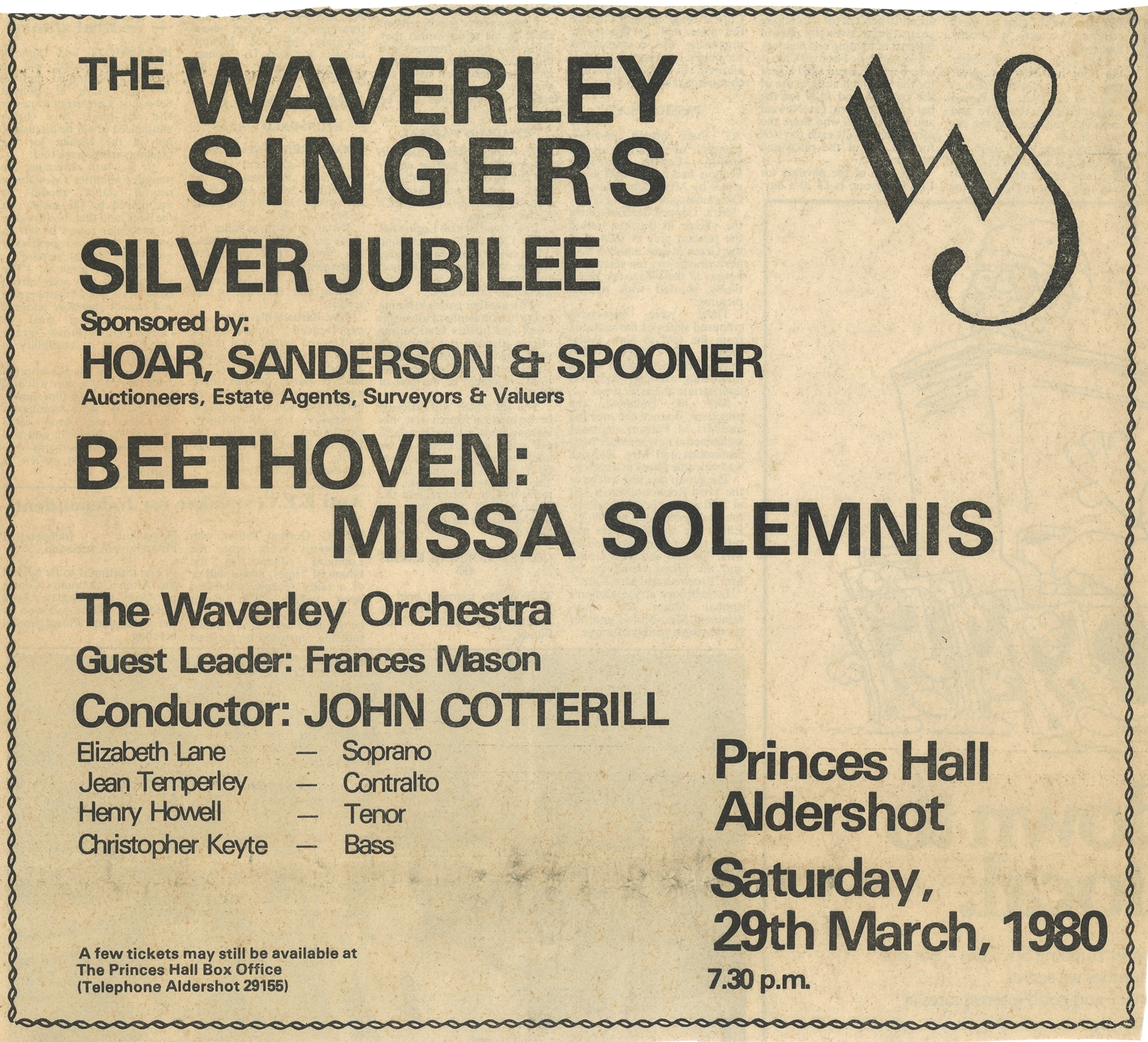
Soprano: Elizabeth Lane
Alto: Jean Temperley
Tenor: Henry Howell
Bass-Baritone: Christopher Keyte
The Waverley Orchestra, Guest Leader Frances Mason
Berlioz: Waverley Overture
Beethoven: Missa Solemnis
- Kyrie
-Gloria
------Interval------
- Credo
-Sanctus
-Agnus Dei
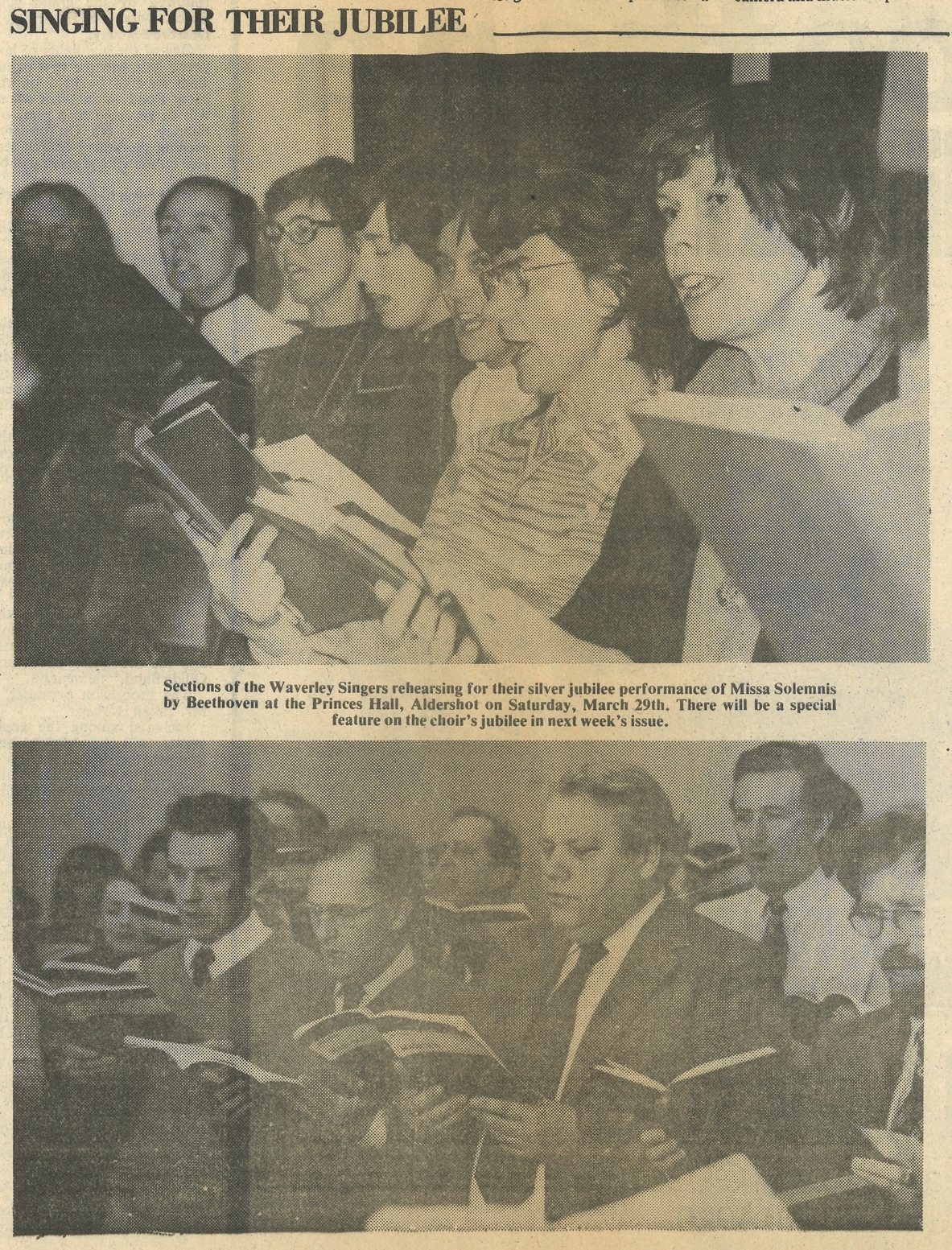
This was the Waverley Singers' Silver Jubilee Concert, well-publicised in advance in the Herald newspaper and elsewhere!
On 18 January, the following letter from John Cotterill, the Waverley Singers chairman/conductor, appeared in the Herald newspaper:
Calling all Waverley Singers members
"Sir - please may I use your columns to seek our former members of the Waverley Singers?
Many of you readers may well be in touch with some of those who have sung with us in the past, but who perhaps no longer live in this area, and I should like them to know that in this year of 1980 the choir celebrates its Silver Jubilee.
We shall be marking our 25th birthday with a special performance of Beethoven's Missa Solemnis on Saturday, March 29, in The Prince's Hall, Aldershot. It would give me very great personal pleasure to see in the audience as many former members as could arrange to be there. We already know of one founder member who is determined to come all the way from Australia especially for the occasion!
I should be delighted to hear from anyone who would like further information. "
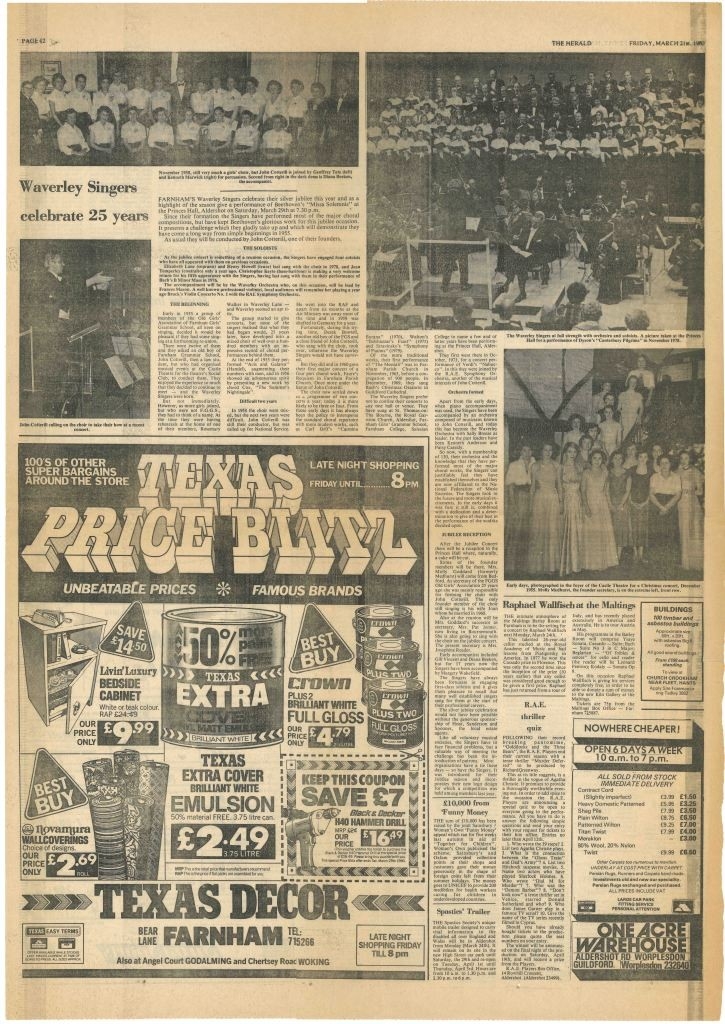
25 Years of the Waverley Singers Recalled
On 21 March, The Herald published a detailed account of the first 25 years of the Waverley Singers' history, which can be viewed here. This piece also includes an account of the speeches that were made at the reception after the concert.
On 25 March, the newspaper carried a short article under the following headline:
Waverley Singers Jubilee
"All seats have been sold for Saturday's Silver Jubilee concert of the Waverley Singers at The Prince's Hall, Aldershot. However, judging on past experience, the Singers anticipate that, for one reason or another, there will be some tickets returned. They, therefore, advise those who wish to hear the performance of Beethoven's Missa Solemnis to come to the hall in good time, and they may still be fortunate and find there is a seat."
Celebratory reception after the concert
The concert was followed by a Reception held at The Prince's Hall. The image below shows the birthday cake being cut by Molly Goddard (née Medhurst), Founder Secretary. There is also an image of John Cotterill being presented with a silver baton by choir member Pat Beer. The group picture shows, from left to right: Molly Goddard; Josephine Reader, Secretary from 1972; Joan Cotterill, the only surviving Founder Member still singing in the choir; John Cotterill, Founder Conductor; George Baxter, former Head Teacher of Farnham Grammar School, who gave the toast at the Reception; Rosemary Walker, Founder Member, in whose house at 19 Waverley Lane in Farnham the first rehearsals took place; this provided the inspiration for the name "Waverley Singers"!
Reviews
Waverley Singers celebrate 25 years
The following review by ‘DAB’* was published in The Herald newspaper on 4 April 1980.
Waverley Singers celebrated their silver jubilee memorably on Saturday with a much-acclaimed performance of Beethoven's Missa Solemnis to a packed audience at the Princes Hall, Aldershot, followed by a reception for their many friends and supporters, a number of whom came from all parts of the country, and in one instance Australia.
The Concert - Rare musical treat
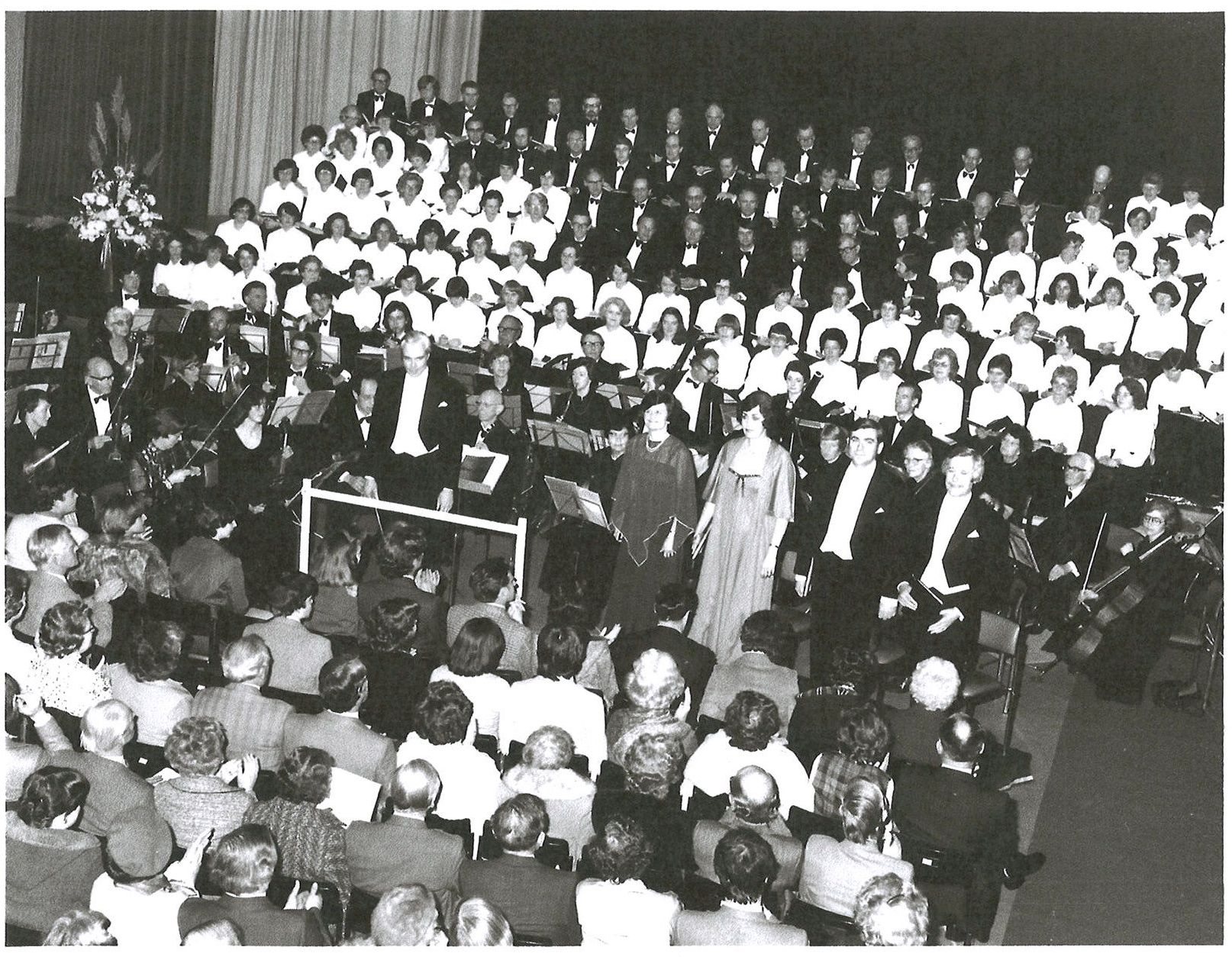
There seemed to be a special atmosphere generated by the Waverley Singers and orchestra at the Princes Hall, Aldershot, on Saturday. The choice for their Silver Jubilee offering of works by Berlioz and Beethoven could not have been bettered to suit the occasion, and with the distinguished quartet of soloists and their conductor, John Cotterill, flanked by two magnificent sprays of flowers, there was a splendid sense of occasion and a performance which will long live in the memory.
As I have been associated with the Waverley Singers during its first 25 years, I might perhaps lavish nothing but unstinting praise in this report. If I did this, however, I would be doing the performers and their conductor a disservice. John Cotterill has always striven towards the highest musical standards, and his performances over the years have demonstrated a dedication through careful rehearsal and research into each work, which has been second to none.
The overture "Waverley" by Berlioz was an appropriate beginning to the concert. Although, as the souvenir programme with its excellent descriptive notes informed us, its suitability lay purely in its title and not in any musical or local connection. The quiet opening pages of the work were successfully negotiated by the orchestra, with beautiful string tone from the ‘cellos and the chording of the woodwind section particularly admirable. Within the brass section, however, there was a noticeable slight hesitancy in some exposed chording, which occurred again in similar circumstances in the Kyrie section of the Mass. This, I felt, was partly due to the unfamiliar siting of the brass.
The overture moved majestically to its conclusion by way of the Allegro, and the brass provided a rich sonority, which is such a feature of Berlioz's orchestral writing and more than made up for the earlier discrepancy. The strings provided as much as their numbers could allow, but it seems such a pity that the composition of this very fine orchestra laboured with too few upper strings. The warm, strong body of tone which Berlioz demands was the only thing lacking in the Allegro of this overture. I am sure that there are many hidden amateur string players in this musical district who could provide the necessary number which the orchestra so richly deserves.
Waves of glorious sound
The remaining music until the interval was made up of the Kyrie and Gloria sections of the Missa Solemnis of Beethoven. Crisp entries by all sections of the choir were immediately evident, and they carried themselves along through waves of glorious sound as if this special occasion buoyed them up. The only thing which seemed to get lost was the occasional third syllable of ‘Kyrie’. The dynamics were particularly praiseworthy in these opening movements, where the focusing of the choral sound to the four soloists was achieved with excellent diminuendos in the Gratias Agimus Tibi section. Crescendos proved to be thrilling moments too.
The soloists, Elizabeth Lane (soprano), Jean Temperley (contralto), Henry Howell (tenor), and Christopher Keyte (bass-baritone), achieved a splendid balance when singing together. Their individual voices rode the sound of orchestra and choir with no evidence of stretching, as the conductor held all forces within a manageable range.
Elizabeth Lane sang radiantly throughout the evening. What a pleasure it is to have a soprano voice which does not jar! Jean Temperley's contribution in this work was always deeply felt in its execution, but I think that her tone might have been brightened and helped with a less serious facial expression. Henry Howell sang with a rich tenor in all his contributions, and Christopher Keyte provided a firm foundation for this excellent team of soloists.
The men in the choir excelled in their tone during In Gloria Dei Patris, and the sound which brought the Gloria section of the Mass to its close rang out magnificently through the rafters and achieved an echo which I dare to say is a rare event at the Prince's Hall!
Now we come to an eternal dilemma concerning Beethoven's Mass in D. Does a conductor choose to perform the Mass with or without a break? It seems likely that he is bound to lose either way on account of the high tessitura of the voices, which is so demanding on the singers. To perform the work without a break means that tiredness can show towards the end. To break in the middle risks the interruption of the overall conception of the performance and the difficulty of establishing again the thrilling atmosphere created by the end of the first two sections. John Cotterill chose the latter quite rightly, but the choir suffered in its pitch immediately after the interval. It is a credit to the choir, however, that this error was quickly adjusted and the remaining parts of the Mass were sung with aplomb.
Of the Credo, one applauds the feeling evoked by the men of the choir in "Et incarnatus est", the quartet of soloists in the "Crucifixus", the running strands of the fugal part of "Et vitam venturi seculi", and the management of the difficult ending of the Credo section.
What surely justified the breaking of the Mass into two followed in the Sanctus. Having rested their voices in the interval, the singers, both solo and choral, produced an exceptional musical experience as the solo singers eventually handed over to the choir. There were tricky choral entries in the "Hosanna in excelsis", and the Waverley Singers sustained a well-judged choir tone. In the latter part of the Sanctus, the violin solo, beautifully performed by the guest leader of the orchestra, Frances Mason, was sensitively anticipated by the viola section of the orchestra and added greatly to the enjoyment, as did the singing of Jean Temperley and Christopher Keyte in the Benedictus. The direction of this movement was achieved with fine musicianship from the tip of the baton as the various forces were moulded deftly by the conductor into a satisfying entirety.
The Agnus Dei served as a deeply felt, prayerful conclusion to the evening's music, with the men of the choir and Christopher Keyte again matching the sincerity of the words with their singing. The orchestra proved to be an ideal background onto which the voices painted their various colours during the mass. Where the instruments came into the limelight, each section played its part with sincerity.
Ladies of the choir
I have purposely left mention of the ladies of the choir till last. In Beethoven's choral writing, the exacting high tessitura of the voices cannot but expose any inadequacies which might exist in a choir. In fact, the soprano line is often the most exposed of all. That the brilliant tones sustained throughout the evening, when demanded by Beethoven and the conductor, only fell just short of the illusion of effortlessness of the ideal attempted by all choral groups is a worthy tribute to the ladies of the Waverley Singers. It served to be a pleasant reminder of the standard of excellence which has been the hallmark of this group of singers since its inception with the group of young ladies 25 years ago.
The bouquets at the end of the performance, and the generous warmth of applause which filled the Princess Hall on Saturday, was an outward expression of an audience which rewarded a group of musicians for a rare musical treat on the day. They also expressed the thanks and affection which audiences over the years have felt for this fine ensemble under the direction of its gifted conductor and founder, John Cotterill.
* We suspect this to have been Derek Bowtell, who played a key role in keeping the choir alive when John Cotterill left in 1958 for two years' national service. (See history article linked above.) A number of reviews are signed ‘DAB’.
Gallery


Youtube