

Haydn, Bruckner, Mozart
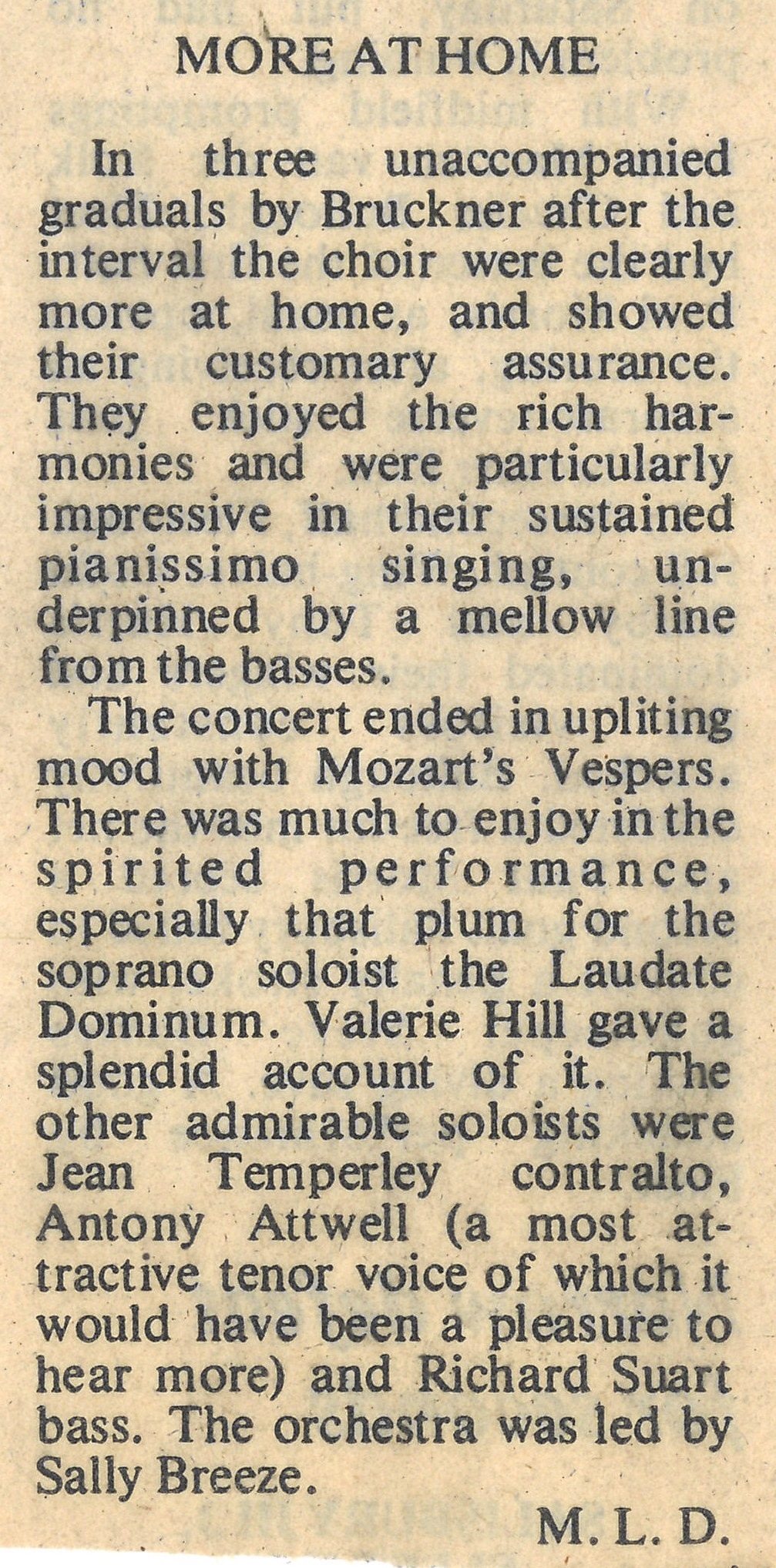
Soprano: Valerie Hill
Alto: Jean Temperley
Tenor: Anthony Attwell
Bass: Richard Stuart
The Waverley Orchestra, Leader Sally Breeze
Haydn: The Seven Last Words Of Our Saviour From The Cross
------Interval------
Bruckner: 3 Graduals
- Locus Iste
- Os Justi
- Christus Factus Est
Mozart: Solemn Vespers K339
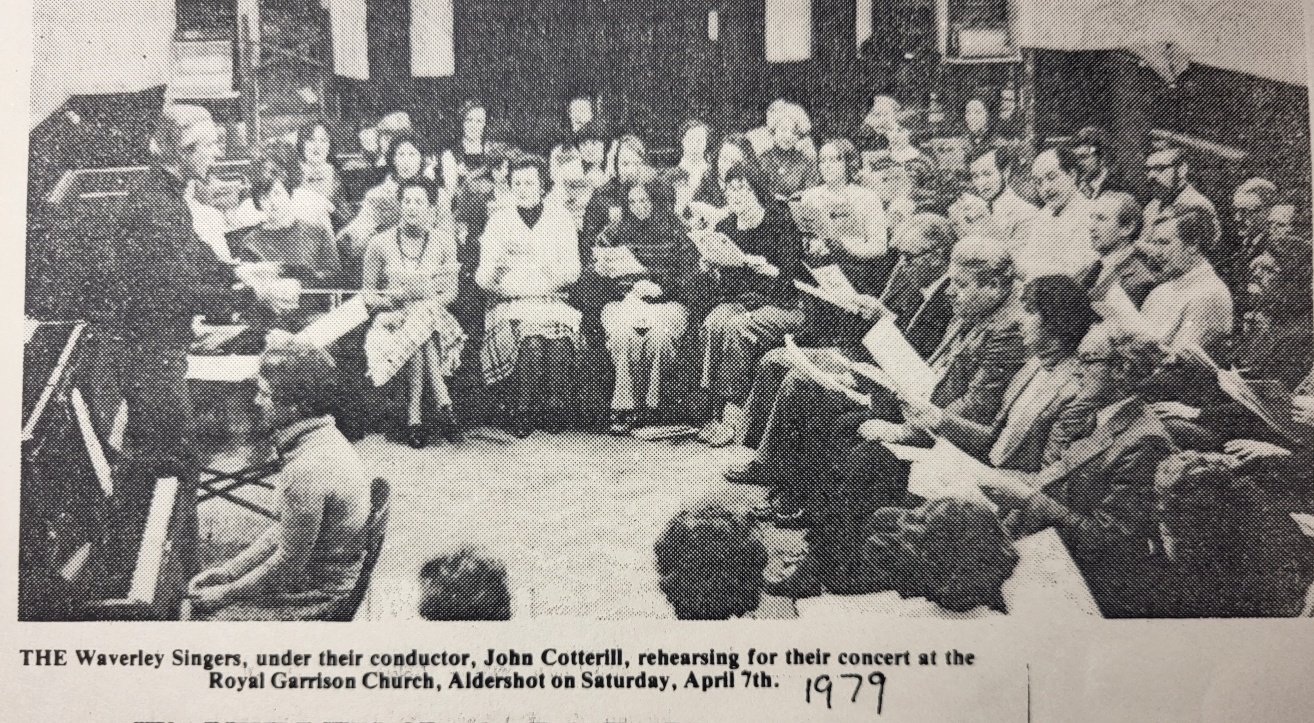
Ahead of the concert, the following article appeared in the local press:
Waverley Singers rehearse for forthcoming concert
Those who remember the Waverley Singers' performance of Rossini's "Petite Messe Solennelle" in the Bourne Church last year will be pleased to know that three members of the solo quartet on that occasion - Valerie Hill (soprano), Jean Temperley (contralto), and Richard Suart (bass) - are making a welcome return to the area.
Together with Anthony Atwell (tenor), also known to Farnham audiences, they will join the Waverley Singers at the Royal Garrison Church, Aldershot, on Saturday, April 7, in a performance of Haydn's Passion - known to many as The Seven Last Words - and Mozart's Vesperae Solennes de Confessore. Contrary to what the title suggests, Mozart's Vespers are certainly not solemn, the whole work being lively and joyous.
To complete the programme, the Waverley Singers, under their conductor John Cotterill, will sing three Graduals by Bruckner - unaccompanied anthems which should be well suited to the acoustics of the lovely Royal Garrison Church.
The Waverley Orchestra will be led on this occasion by Sally Breeze, and a heavy demand for programmes is anticipated for this, the Waverley Singers' first concert since their Christmas performance of the Messiah at the Maltings. Full details are to be found in the advertisement on page 2.
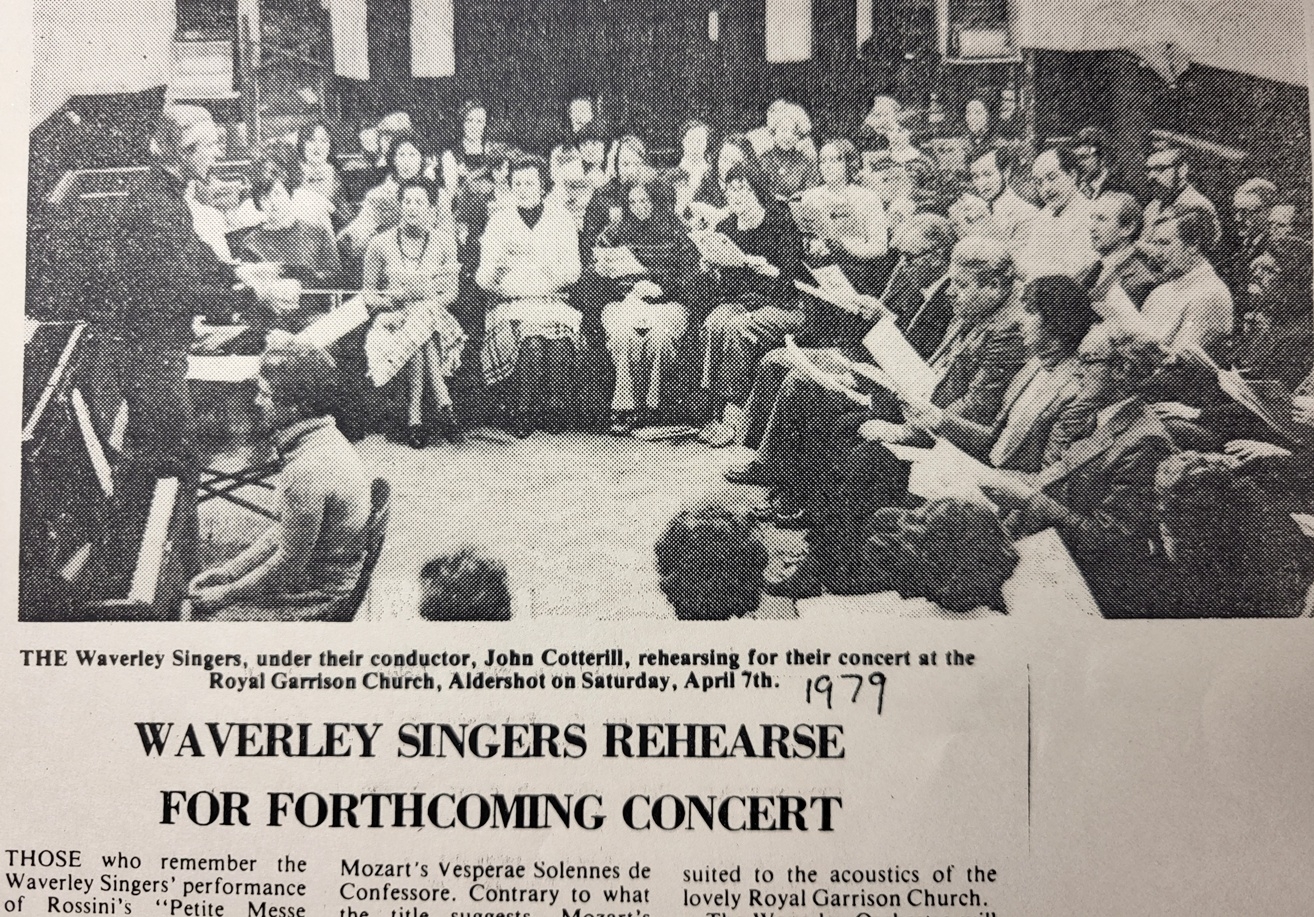
The article was accompanied by a nice picture of the choir rehearsing for the concert. See below.
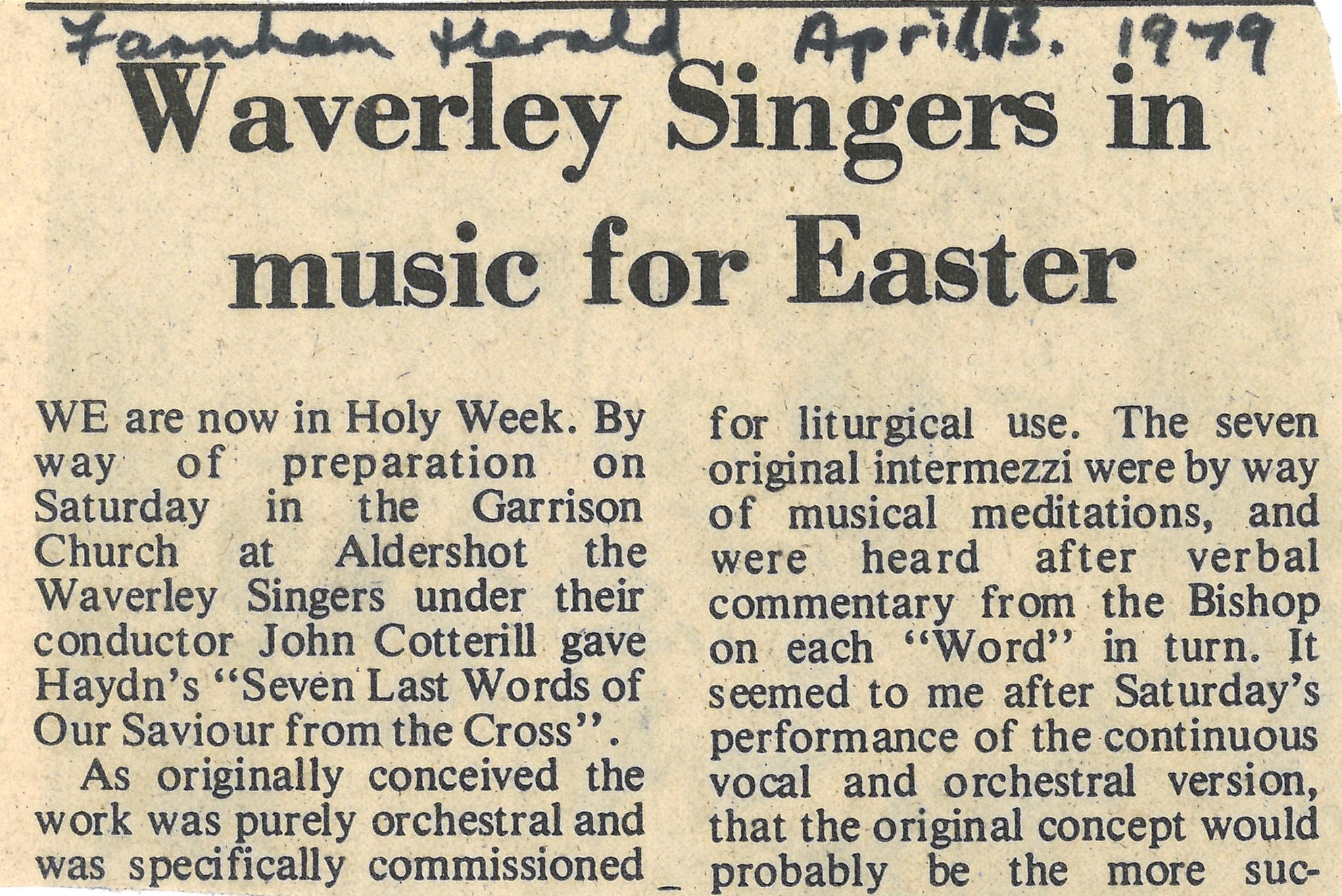
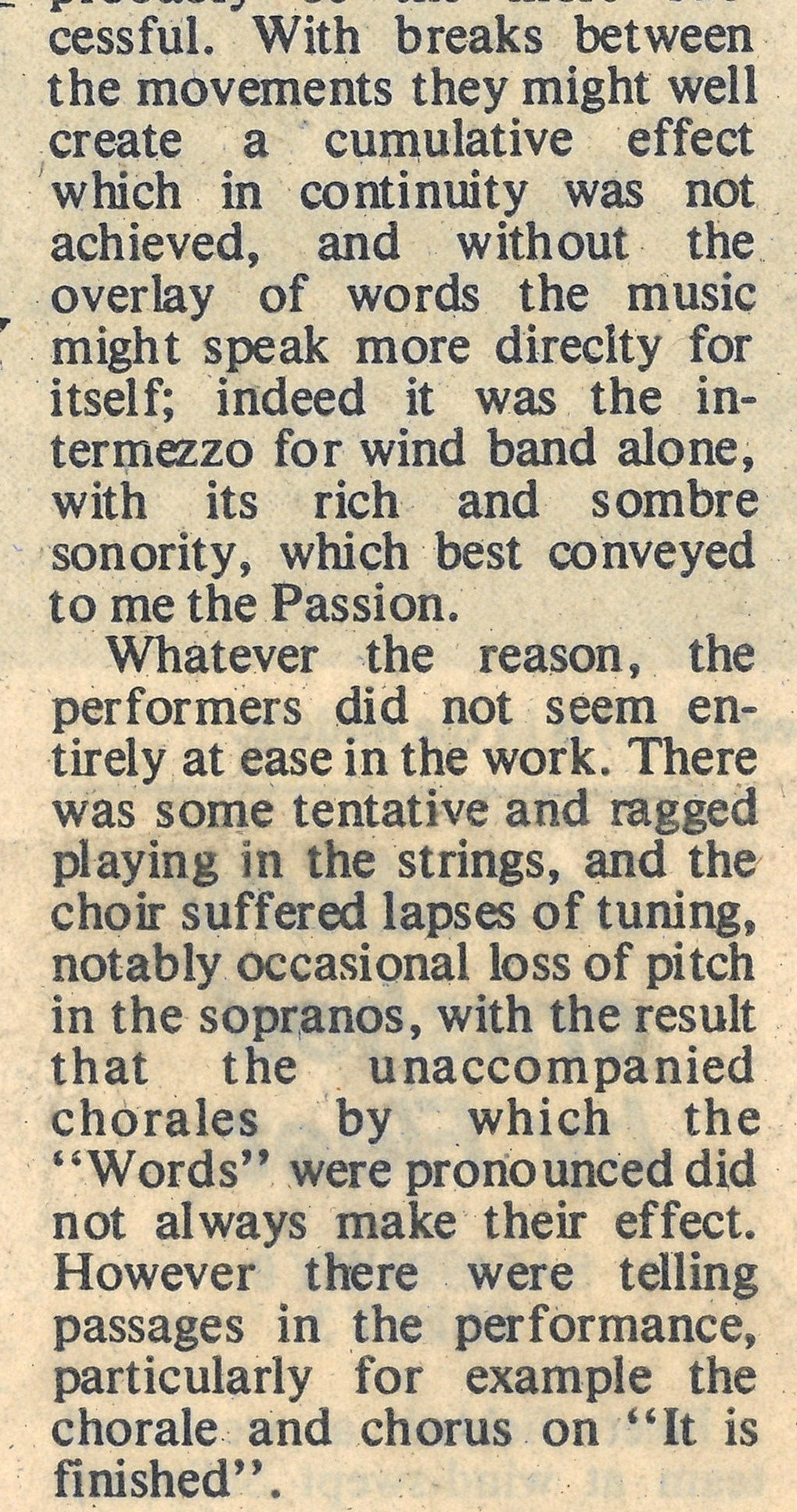
Not long after the concert, a letter was published in response to the review reproduced below, as follows:
Waverley Singers Concert
Sir - the task of a music critic is a pretty thankless one; if he is fulsome in praise, he is not believed, or he is thought to be currying some sort of favour; if he comments adversely, he could be considered ignorant or a churl.
I wish to upset no one, but I must speak in defence of string orchestral players in general, and in particular of some, who in last week's issue of your paper were adjudged by "MLD" to have played tentatively and raggedly at the Waverley Singers concert in Haydn's "Passion". His assertion may well be true, I do not know, for I was not at the concert owing to illness, but I did play in rehearsal a few days before and found conditions rather trying - barely enough room to bow, certainly not enough light, and in the case of the "Passion", a tatty score. The parts (Novello) must have been printed 100 years ago - figure 7 crotchet rests, bad spacing through the bars, tails and stems the wrong way round, wrong notes, wrong time figures, missing dots, illegible accidentals, and inevitably appoggiatura worries. Add to this a generous supply of pencil markings for the bowing and the necessity to watch the conductor, and I, for one, am not surprised if there was raggedness.
None of this is the fault of Mr Cotterill; there is little choice of where to perform or wherefrom to hire music; and "MLD" cannot be blamed for saying what he did. But the saying of it reminded me of a certain lady who, needing new music glasses, took her own piece of music to the optician, set up the stand a good 3 or 4 feet away at an awkward angle, and then asked for half the lights to be turned out, "These, sir, are the conditions under which we are, all too often, called upon to play."
Sidney Fincham
Lower Bourne
Reviews
Gallery
Youtube